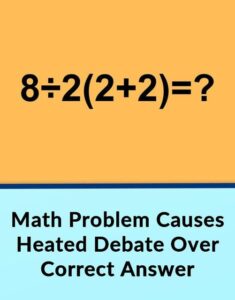
In a world where social media thrives on polarizing debates, one would hardly expect a math problem to spark such a heated conversation. But one equation did just that.
In 2019, a seemingly simple math equation became a viral problem for social media users and “practically caused a civil war in thePopular Mechanics office.”
At its core, this wasn’t just about math; it was a cultural phenomenon, showcasing how people interpret rules differently and, sometimes, fiercely defend their perspectives.
Let’s break down the drama and explore why this problem became so controversial.
Math isn’t always fun
The problem reads:
8 ÷ 2(2 + 2)
At first glance, it seems straightforward. But the simplicity is deceptive. Depending on how you interpret the order of operations, the answer could either be 1 or 16.
According to the PEMDAS/BODMAS rule (Parentheses/Brackets, Exponents/Orders, Multiplication and Division, Addition and Subtraction), equations or problems should be solved in the order specified by the acronym, starting with parentheses, followed by exponents, and continuing through the remaining operations – always working from left to right.
This means that the 2 + 2 in the parenthesis should be solved first, leaving people with 8 ÷ 2 x 4. After this, the equation calls for solving the leftmost operation first, so 8 ÷ 2 must be solved first rather than 2 x 4.
This gives us 4, leading to 4 x 4, equaling 16.
- 2 + 2 = 4
- 8 ÷ 4 = 4
- 4 x 4 = 16
However, a significant portion of the online community disagrees with this interpretation, including some mathematicians who are well-versed in the subject.
Mike Breen of the American Mathematical Society Public Awareness Office said, “the way it’s written, it’s ambiguous.”
Working with Popular Mechanics in solving this equation, Breen adds “In math, a lot of times there are ambiguities. Mathematicians try to make rules as precise as possible. According to strict order of operations, you’d get 16, but I wouldn’t hit someone on the wrist with a ruler if they said 1.”
The case for 1
How did they get 1 as an answer?
The team followed the PEMDAS rule but interpreted it differently. While they agreed that the 2 + 2 inside the parentheses should be solved first, they argued that the resulting sum should be treated as if it were still within parentheses, essentially rewriting the equation as 8 ÷ 2(4), which gives us 1.
Weighing in on the massive problem, Rhett Allain, Ph.D., Associate Professor of Physics at Southeastern Louisiana University, says “This is the math version of, ‘What color is this dress? Blue and black or gold and white?’”
Rhett says the answer is 16.
“Of course this isn’t math. This is convention. We have conventions on how to write these things just like we have conventions on how to spell stuff. But still, there are different conventions. Some people spell it as ‘gray’ and others as ‘grey.’” He adds, “We still understand what’s going on. For me, I would write this more explicitly so that there is no confusion…That way no one will get it wrong.”
Whether you’re on team 16 or team 1, this viral phenomenon proves one thing: math has never been so confusing or more entertaining! So, which side are you on? Let us know in the comments!
