Online “odd one out” puzzles have become a popular way to entertain ourselves, but they also reveal something interesting about how people naturally notice and sort information. A familiar version of this challenge shows five animals—a crab, fish, frog, toad, and turtle—and asks viewers to choose the one that feels different. There’s no correct answer. Instead, the puzzle encourages quick, instinctive choices and highlights how people explain what caught their attention. It’s a simple activity that shows how differently we observe, compare, and interpret even the most familiar creatures.
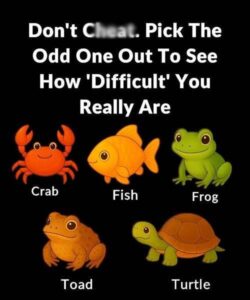
Many people immediately choose the crab because it looks so distinct. Unlike the others, it has a compact body, multiple legs, and pincers, making its appearance noticeably different. Those who pick the crab tend to rely on visual structure or clear physical contrasts. This approach reflects a preference for straightforward comparisons based on shape or movement.
Others select the fish, not because of its appearance, but because of its environment. While the crab stands out visually, the fish is the only animal that lives entirely in water. People who choose the fish often think in terms of habitat and survival, focusing less on physical traits and more on where each creature lives.
Some participants point to the frog, noting that its life cycle—from tadpole to adult—is unique. This transformation sets it apart biologically. Similarly, others choose the toad, picking up on subtle differences such as drier skin or different habitat preferences. These choices often come from careful observers who notice small but meaningful details.
Finally, many identify the turtle as the odd one out because it belongs to a different biological category. It’s the only reptile in the group and is recognized by its protective shell. This answer appeals to those who think in terms of scientific classification. In the end, the puzzle reminds us that there isn’t one right way to see the world—only different perspectives shaped by what we notice first.
