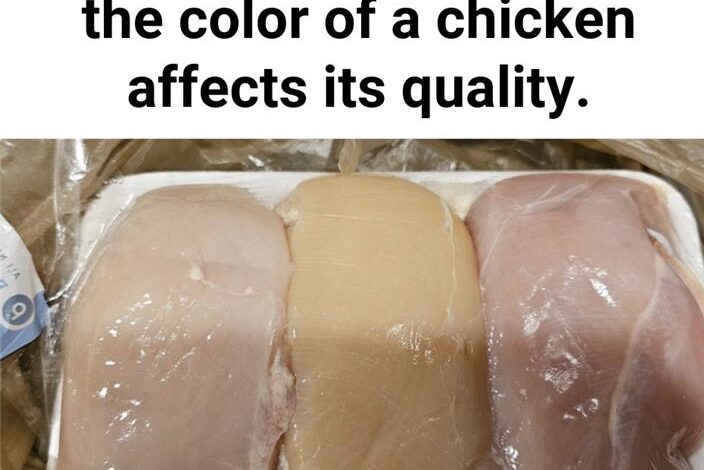
Most people don’t think twice when they walk past the poultry section at the supermarket. A pack of chicken is a pack of chicken — or so it seems. But every once in a while, someone pauses and notices something odd. Two trays sit side by side, both labeled “chicken,” yet one is pale and nearly white while the other has a rich yellow tint. Same cut, same price range, completely different color. Suddenly the questions start: Is one fresher? Is one healthier? Did something go wrong with the pale one… or the yellow one? The truth behind the color difference goes deeper than most shoppers realize, and it says a lot about how chickens are raised, what they’re fed, and what kind of life they lived before ending up in a grocery cooler.
White chicken — the kind most of us grew up seeing — usually comes from large commercial poultry farms. These birds are kept indoors in controlled environments, fed standardized diets heavy in corn, soy, and wheat. It’s efficient, predictable, and designed to grow chickens quickly with minimal movement. They spend their lives indoors with limited sunlight and little opportunity to forage or roam. As a result, their meat tends to be pale pink or even slightly bluish in some areas. The skin stays light because there’s no dietary pigment and very little natural carotenoid intake.
Yellow chicken tells a different story. Birds raised more naturally — whether free-range, pasture-raised, or fed diets that include greens and marigold petals — ingest carotenoids that tint their skin and fat. These same pigments turn carrots orange and give flamingos their signature color. A chicken that roams outdoors, eating bugs, grass, seeds, and plants rich in natural pigments, will often develop a deeper yellow tone. Some regions of the world even consider yellow chicken superior in flavor and nutrition, associating the golden hue with old-fashioned farming and richer taste.
Is yellow chicken healthier? It can be, but not automatically. The color hints at dietary differences, not quality on its own. Many pasture-raised birds are undeniably healthier — they get exercise, exposure to sunlight, and diverse nutrition. That lifestyle produces firmer muscles, better fat profiles, and more pronounced flavor. Their diets naturally contain antioxidants, omega-rich seeds, and leafy greens, all contributing to the yellowing effect. But the poultry industry knows consumers associate yellow chicken with “healthier,” so some farms add supplements like lutein or marigold extract to achieve the color artificially. It doesn’t make the bird unhealthy, but it does mean color alone can’t determine quality.
Understanding labels helps. “Free-range” in the U.S. only guarantees access to the outdoors — not how often the chickens actually go outside. The door may open onto a small dirt patch they rarely use. “Pasture-raised,” on the other hand, indicates significant outdoor time and space. Organic certification restricts antibiotics and feed additives, and “Certified Humane” or “Animal Welfare Approved” labels provide even more assurance about living conditions. These details matter far more than whether the chicken is white or yellow.
Flavor differences also trace back to lifestyle. Chickens that move more develop stronger, firmer meat, which holds up better in long cooking and carries deeper flavor. Many chefs prefer them for soups, stews, and braised dishes because the broth turns richer and the meat stays intact. Factory-farmed chickens, with their rapid growth and limited movement, produce softer meat with higher water content. That’s why some store-bought chicken breasts release excess liquid in the pan — it’s not your cooking; it’s the bird’s upbringing.
Even chicken skin tells a story. In some cultures, yellow chicken skin is prized, associated with superior texture and deeper taste. In others, white skin is seen as “cleaner” or more neutral. Neither interpretation is wrong. Much of it comes down to generational preference, the foods people grew up with, and regional farming traditions. The skin color doesn’t determine safety or freshness, only diet and environment.
If you want the best chicken — nutritionally and in terms of flavor — think beyond color. Choose birds from sources you trust. Look for firm texture, clean smell, and proper cold storage. Visit farmers markets if possible, where you can actually ask farmers what their chickens eat. If buying in-store, check for visible water pooling in the package — a sign of excess moisture content — and avoid any with a sour or metallic odor.
The difference between yellow and white chicken touches on a broader truth: most people don’t realize how much lifestyle translates directly into food quality. Chickens raised in sunlight with space to roam, eating bugs and plants that mirror their natural diet, simply develop richer, more nutrient-dense meat. Chickens raised indoors in large-scale facilities grow bigger faster but without the depth of flavor or nutrient variation.
At the end of the day, the color is just the first clue. The real story is in how the bird lived. A golden tint can signal a more natural upbringing, but only if the farming practices match the color. When in doubt, labels matter more than hue, and taste tells the rest.
So next time you’re in the store and you see a pale breast next to a bright yellow one, don’t assume either is superior based on appearance alone. The truth is a mix of biology, diet, farming method, and regulation — and understanding that makes you a smarter shopper and a better cook. Whether the chicken ends up roasted with herbs, simmered in broth, or sizzling on a skillet, the real decision comes down to what you value: nutrition, ethics, flavor, or simply cost.
Color may begin the conversation, but the deeper story — the life behind the chicken — is what truly separates one from the other.
