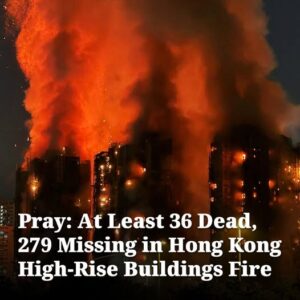
The night it happened, Mei Ling was sitting by her window on the 42nd floor, humming softly while her grandmother dozed beside her. Outside, the city glowed like a sea of stars—steady, familiar, alive. Hong Kong never really slept, and neither did she.
At 10:47 PM, she heard it—the low, trembling hum that felt like the earth exhaling. A second later, the lights flickered. Then everything went black.
At first, she thought it was just another power outage.
Then came the scream.
A shriek echoed from the hallway, followed by rushing footsteps. Mei Ling opened her door, only to be met with a wave of heat so intense it pushed her backward. Flames were already creeping up the stairwell, crawling like living creatures, devouring everything in their path.
“Po Po, wake up!” she cried, shaking her grandmother. But the elderly woman struggled to stand. The smoke was too thick. The alarms were too loud. And the fire—oh, the fire—was rising faster than anyone could understand.
Across the district, hundreds of families faced the same terror.
Some were trapped behind jammed doors.
Some tried climbing twenty, thirty, forty floors in suffocating smoke.
Some never made it out of their kitchens.
On the 18th floor, a father carried both his children, one clinging to his neck, the other sobbing quietly against his chest as he ran through a hallway that was already crumbling. On the 51st floor, a newly engaged couple held each other by the window, whispering apologies and promises as the heat swallowed the room.
The fire raged like a monster awakened—orange spirals twisting into the sky, sparks raining like falling stars.
Rescue teams arrived in minutes, but minutes were too long. The wind pushed the flames from tower to tower, turning steel, glass, and human lives into one giant inferno. Firefighters battled the blaze from every direction, but the fire climbed higher, angrier, unstoppable.
By midnight, the skyline was unrecognizable.
By 1 AM, entire families were missing.
By morning, the world woke to numbers nobody knew how to process:
36 dead.
279 missing.
Hundreds broken.
Thousands grieving.
But numbers could never capture the silence left behind.
The empty chairs.
The unanswered messages.
The toys left on floors that no longer existed.
The photos buried under ashes.
The dreams that would never be lived.
Days later, survivors gathered near the ruins. They held candles that flickered weakly against the blackened sky. Mei Ling’s brother searched desperately through rescue lists, clinging to hope, though each hour chipped away at it.
“We’ll find them,” he whispered, voice trembling. “We have to.”
Around him, others whispered the same prayers. Some begged. Some blamed the heavens. Some simply stared, broken, as the smoke curled upward, as if carrying the souls of those lost.
The city that never slept suddenly felt unbearably quiet.
Yet in that silence, something else grew—a fragile, trembling unity. Strangers embraced. Volunteers brought blankets, water, hope. Firefighters stood with tears of exhaustion on their faces. People who had never met mourned together as if they had lost their own blood.
And as dawn approached, the first light touched the ruins, revealing something the fire could not destroy:
The love people had for each other.
The memories carved into every brick.
The unbreakable human spirit that rises even when everything else falls.
The buildings would be rebuilt.
But the stories—those heartbreaking, irreplaceable stories—would live forever in the hearts of a city that refused to forget.
