On a quiet winter morning, in a small forgotten village at the edge of the valley, a soft cry echoed through a wooden house that had seen more years than most people who passed by it. That cry belonged to a child—tiny, fragile, new to the world. His name was Elias.
Elias did not know the meaning of beginnings or endings. He didn’t know that the woman holding him—her hands trembling with age yet steady with love—was the only person he had left. He didn’t know that life had already taken more from him than it had given.
Grandmother Mira had raised children before, but none under these circumstances. Elias’s mother, her only daughter, had taken her last breath before she ever got to see her son open his eyes. His father, overwhelmed by grief and poverty, had disappeared into the world like dust carried by the wind, leaving the newborn in Mira’s arms.
And so, on that day, the boy began his life with only one person in his universe.
A Year of Silent Battles
Grandmother Mira was already old—too old, people whispered, to raise a baby. Arthritis had claimed her fingers, and time had softened her bones. Yet every day she rose before the sun, warming milk on the stove, humming songs she remembered from her own childhood.
Nights were long. Elias cried often—sometimes from hunger, sometimes from dreams he was too small to understand. Mira would rock him patiently, her voice soft, her heart steady, even as her own tears fell quietly into his blankets.
There were nights when she worried she wouldn’t wake up the next morning—that she would fail the little boy who relied on her breaths, her touch, her heart. So she fought harder. She prayed louder. She loved deeper.
The First Birthday
When the day finally arrived—Elias’s first birthday—snow had begun to settle on the rooftops. The house was cold, but Mira’s determination was warm and fierce.
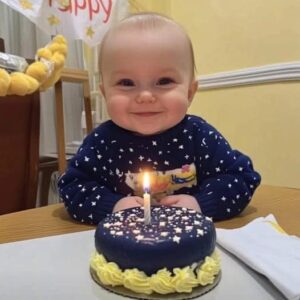
She spent hours making a small cake. Flour covered her hands, sugar coated the counter, and the smell of vanilla traveled through the tiny rooms. It wasn’t perfect. The icing leaned to one side, and the candle she found in an old drawer was crooked. But it was hers. And it was his.
When she placed the baby in front of the cake, Elias reached out with his tiny hands, touching the soft frosting with curiosity. Mira laughed—a sound she hadn’t heard from herself in months. She wiped the tears from her eyes, but they kept falling, one after another.
“Happy birthday, my little heart,” she whispered. “I don’t know if I’ll be here for all the others… but I’m here today. And I love you more than anything.”
The candle flickered gently. The room was silent, except for the faint crackle of the old stove. Elias smiled, as if he understood the weight of her words—the depth of her fear, the strength of her love.
And in that moment, Mira felt something she hadn’t felt in years: hope.
A Candle That Never Went Out
Long after the cake was gone and the day had ended, the memory of that candle lived on. It became a symbol of everything she had fought for—every night she stayed awake, every meal she skipped so he could eat, every prayer whispered into darkness.
People in the village would say that the house on the hill held two souls bound together by love stronger than blood, stronger than fate.
And though the world had taken much from Elias, it had left him with the one thing many never receive:
A love so powerful that even time could not erase it.
Because sometimes, the most beautiful families are the ones built from broken pieces that refuse to fall apart.
