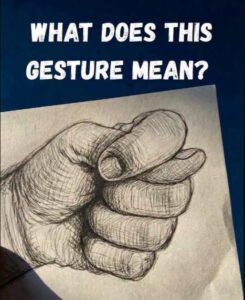
One of the most intriguing things about the fig sign is its contradictory symbolism.
In some traditions, it has been understood as a protective gesture.
In others, it has been considered vulgar or insulting.
That may sound strange, but human gestures often work this way.
A particular hand position can be comforting in one culture and offensive in another.
The fig gesture is a perfect example.
A Symbol of Protection
In some Mediterranean and European folk traditions, making the fig gesture was associated with protection against the evil eye or bad fortune.
The evil eye is a longstanding folk belief in which envy or an envious gaze is thought to bring misfortune.
People developed many protective customs around this belief, including amulets, charms, prayers, and gestures.
The fig sign became one of the gestures associated with that protective tradition in some settings.
In this interpretation, the hand becomes almost like a tiny personal talisman.
A person doesn’t need an object to carry with them.
Their own hand becomes the protective symbol.
The Fig Sign as a Gesture of Rejection
The gesture has also been connected with rejection and refusal.
In some historical and cultural contexts, making the sign could communicate something along the lines of:
“No.”
“I reject this.”
Or, more symbolically, “Keep this away from me.”
That protective meaning and the idea of rejection actually fit together rather naturally.
Whether someone was attempting to ward off misfortune, reject an unwanted influence, or simply express refusal, the gesture could serve as a silent response.
When a Small Gesture Becomes an Insult
There’s another side to the fig gesture that is considerably less innocent.
In certain cultures and periods, the gesture has carried obscene or insulting connotations.
Its symbolism has sometimes been interpreted sexually, which helps explain why it could function as a provocative or offensive gesture.
This is a useful reminder that gestures cannot always be translated literally.
Someone unfamiliar with the cultural context might see nothing more than a fist.
Someone who understands the symbolism might see something completely different.
The Connection With the Evil Eye
Perhaps one of the most interesting aspects of the fig gesture is its connection with protective folk traditions.
The evil eye is a belief found in many cultures, particularly around the Mediterranean, the Middle East, and other parts of the world.
Although traditions differ considerably, the basic idea involves the possibility that envy or a harmful gaze could bring misfortune.
People have historically responded to this belief in many ways.
They might wear protective charms, use particular phrases, make symbolic gestures, or follow specific customs intended to keep misfortune away.
The fig gesture was one such symbolic gesture in some traditions.
Whether viewed as superstition, folklore, or cultural heritage, it reveals something very human:
People have always searched for small ways to feel protected when life feels uncertain.
A Silent Language Before Words
Imagine living in a society where speaking openly wasn’t always easy.
Perhaps you didn’t want to challenge someone publicly.
Perhaps you wanted to reject something without attracting attention.
Or perhaps you simply wanted to communicate with someone across a room.
A gesture could accomplish what words couldn’t.
Of course, we should be careful about romanticizing the past or claiming that ordinary people routinely used the fig sign as a secret code against authority. The historical meanings of gestures varied considerably by place and period.
But the broader idea is fascinating:
Human beings have always used their bodies to communicate messages that don’t need to be spoken aloud.
A raised eyebrow.
A wave.
A crossed finger.
A thumbs-up.
A clenched fist.
And, in certain traditions, the fig gesture.
Why Hand Gestures Are So Fascinating
We often think of language as something spoken.
But communication is much bigger than words.
Our hands can express agreement, rejection, affection, warning, frustration, humor, and countless other emotions.
The same movement can even mean completely different things in different countries.
That’s why travelers are often encouraged to learn about local gestures before visiting another culture.
A harmless gesture at home may carry an entirely different meaning somewhere else.
Does the Fig Gesture Still Have Meaning Today?
Yes, although its meaning depends heavily on cultural context.
In some places, people may recognize it as a traditional protective gesture.
In others, it may be understood primarily as an obscene or insulting sign.
And plenty of people may simply have no particular interpretation of it at all.
That’s why it’s difficult to give the gesture one universal definition.
There isn’t one.
Its meaning is shaped by culture, history, location, and context.
Frequently Asked Questions
What does the fig hand gesture mean?
The fig gesture can have different meanings depending on cultural context. It has historically been associated with protection from the evil eye and bad luck in some traditions, while in other contexts it has been used as an obscene or insulting gesture.
Why is it called the fig sign?
It’s generally called the fig sign because the position of the thumb between the curled fingers is thought to resemble a fig.
Is the fig gesture offensive?
It can be. In some cultural contexts, the gesture has vulgar or insulting associations. In others, it has been used as a protective folk symbol.
Is the fig gesture used to protect against the evil eye?
In some traditions, yes. The gesture has been associated with protective practices involving the evil eye, although beliefs and customs vary substantially between cultures.
Is the fig gesture the same everywhere?
No.
This is one of the most important things to remember. Hand gestures are culturally specific, and their meanings can change across countries, communities, and historical periods.
Why did people use hand gestures instead of words?
Gestures can communicate quickly and silently. They can also carry symbolic meanings that don’t require spoken language.
The Fascinating Story Behind a Tiny Gesture
It’s remarkable when you think about it.
A tiny movement of the hand can carry centuries of cultural meaning.
The fig gesture has been interpreted in different ways—as a sign of protection, rejection, superstition, fertility, or insult, depending on the cultural setting.
That’s what makes it so much more interesting than it first appears.
What looks like an ordinary fist may actually be part of a much older tradition of using the human body as a form of communication and symbolism.
So the next time you see someone tuck their thumb between two fingers, don’t be so quick to dismiss it as a random movement.
That little gesture may have a story behind it.
And sometimes, the smallest movements can tell us surprisingly large stories about the people and cultures that came before us.