Paul Alexander lived a life unlike many others. For the majority of his life, he’s was inside an iron lung, and he was one of the last people in the world still using the respirator which dates back to the 1928.
Despite his unusual circumstances, he’s lived an incredibly full life and he’s never accepted anything less.
“I am not going to accept from anybody their limitations on my life. Not gonna do it. My life is incredible.”
When Paul was just six years old he ran into his family’s home in a suburb of Dallas, Texas, and told his mother he wasn’t feeling well. Since his birth in 1946, Paul had been a normal, vibrant, and active child – but now something was clearly wrong.
“Oh my God, not my son,” Paul recalled his mother saying.
Following doctor’s orders, he spent the next several days in bed recovering, but the boy clearly had polio, and he was not getting better. Less than a week after he started feeling sick he couldn’t hold anything nor could he swallow or breathe.
His parents finally rushed to the hospital where he joined countless other children experiencing similar symptoms.
Before vaccines were available for polio, more than 15,000 people were paralyzed from the virus. Polio, an incredibly contagious infection, can spread even when an infected person has no symptoms.
The symptoms of polio include fatigue, fever, stiffness, muscle pain, and vomiting. In rarer cases, polio can also cause paralysis and death.
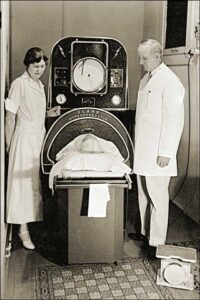
Paul was examined by a doctor and pronounced dead, but then another doctor took a look at him and gave him another chance at life.
The second doctor performed an emergency tracheotomy, and following the surgery, Paul was placed inside an iron lung.
When he eventually woke up, three days later, he was among several rows of children also encased in iron lungs.
”I didn’t know what had happened. I had all kinds of imaginings, like I’d died. I kept asking myself: Is this what death is? Is this a coffin? Or have I gone to some undesirable place?” the Texas native told As It Happens host Carol Off in 2017.
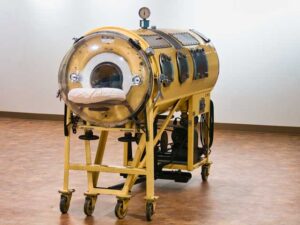
Paul, who also had a tracheotomy, couldn’t speak, making the whole event even more terrifying.
“I tried to move, but I couldn’t move. Not even a finger. I tried to touch something to figure it out, but I never could. So it was pretty strange.”
The machine, invented in the late 1920s, was the first to ventilate a human being. It was often referred to in the early days as the “Drinker respirator” the device is hermetically sealed from the neck down and creates a negative pressure in the chamber that draws air into the patient’s lungs. If it generates overpressure, the air is forced out of the lungs again, and the patient exhales.
Paul spent 18 months inside the metal canister recovering from the initial infection. And he wasn’t alone. The year Paul was infected by the virus, 1952, was a very dark year looking at the statistics.
Almost 58,000 people, primarily children, contracted the virus in the U.S in 1952. Sadly, 3,145 of them died.
“As far as you can see, rows and rows of iron lungs. Full of children,” he said, according to The Guardian.
While some may have given up their will to live, it only fueled Paul’s will.
He would hear doctors say, ”He’s going to die today” or “He shouldn’t be alive” whenever they passed by him, and he wanted to prove them wrong.
