Most people celebrating their 40th wedding anniversary might choose a relaxing cruise or a luxurious beach getaway to mark the special occasion. But for South African couple Marius and Michelle Nortje, nothing could compare to a journey deep into the wilds of Kruger National Park, a place they both cherish dearly. Their love story, which has flourished over four decades, was about to take a unique and unforgettable turn during this particular anniversary trip. The couple, both passionate about wildlife and nature, had made numerous visits to Kruger over the years — sometimes once, sometimes as many as four times a year, making the park a second home of sorts.
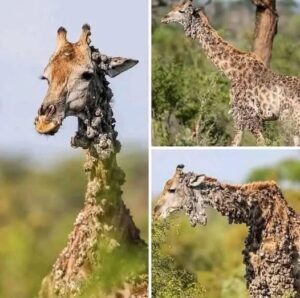
On this trip in December, what began as a routine safari drive quickly transformed into a moment neither Marius nor Michelle would ever forget — and a moment that would soon captivate people worldwide. While searching for lions along the tar road, they found nothing and decided to turn onto a quieter gravel path. It was there that Marius first spotted two giraffes emerging from the dense bush, followed by a third that immediately caught his attention. This particular giraffe was unlike any he had seen before, covered with unusual growths all over her body.
Marius, an experienced wildlife photographer, instinctively raised his camera and captured several images of the giraffe. Later, he shared the photos on Facebook, where they quickly generated curiosity and concern among viewers. Many people wondered if the giraffe was in pain or suffering because of the strange lumps. Despite the unsettling appearance, Marius noted that the giraffe seemed calm and was grazing peacefully, showing no obvious signs of distress. To raise awareness, he tagged the South African National Parks (SANParks) in his post, though at the time of the interview, he had not yet received any official response.
The giraffe’s story drew even more attention after the images were picked up by WorldWide Vets, an international animal welfare organization dedicated to wildlife health. Dr. Gemna Campling, the founder and director of the organization, identified the giraffe’s condition as a rare case of papillomavirus infection. Papillomavirus, Dr. Campling explained, comes in many forms, each targeting specific animal species. In this giraffe’s case, it is believed to be caused by the bovine papillomavirus (BPV), a strain that affects certain animals in the wild.
The virus is typically spread through direct contact, and in this situation, oxpecker birds — which feed on parasites found on the giraffe’s skin — likely transmitted the infection from one animal to another. Interestingly, the rest of the herd appeared healthy and unaffected, a pattern consistent with previous cases of this disease in wildlife populations. Though alarming in appearance, the condition is not fatal. Dr. Campling emphasized that many cases of BPV are self-limiting, meaning they can heal naturally, with the animal eventually recovering fully. Unfortunately, there is no known treatment for this disease in giraffes, but wildlife veterinarians monitor affected animals closely to track their health.
Importantly, the virus cannot be transmitted to humans, though a similar form of papillomavirus does affect people. Dr. Campling also noted that while the disease is not life-threatening, the large, advanced growths likely cause discomfort to the affected giraffe. It is difficult to measure exactly how much pain the giraffe experiences, but the image of her calmly grazing despite the noticeable lumps is both heartbreaking and inspiring. The photographs moved thousands of people online, sparking empathy, wonder, and questions about wildlife health and conservation.
For Marius and Michelle, the experience was a powerful reminder of why they continue to return to the wild year after year. It is in these moments — unplanned and raw — that the true resilience and vulnerability of nature reveal themselves. Sometimes, the most unforgettable and profound experiences happen when you least expect them. And sometimes, it takes the dedicated eye of a passionate nature lover to bring these stories to light, reminding the world of the delicate balance between strength and fragility in the animal kingdom.
