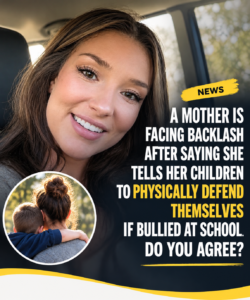
A mother’s advice about how her children should respond to bullying at school has sparked debate, raising an important question for parents: Should children fight back when someone targets them, or should they always walk away and seek help?
Bullying remains a serious concern for families, teachers, and schools. For parents, one of the hardest questions is how to prepare their children to respond when they are mistreated by their peers.
A mother has attracted attention after sharing her approach to the issue, saying that she tells her children to physically defend themselves if they are bullied at school.
Her position has prompted a broader discussion about self-defense, school safety, and the lessons children should learn when dealing with aggression.
While some parents believe children should never be expected to tolerate bullying without standing up for themselves, others worry that encouraging physical retaliation could escalate an already dangerous situation.
Why Some Parents Believe Children Should Fight Back
For parents who support the mother’s approach, the main concern is ensuring that children do not feel powerless when confronted by a bully.
They argue that children should learn to establish boundaries, speak confidently, and protect themselves if they are physically attacked.
Some also worry that telling children simply to ignore bullying may leave them feeling unsupported, particularly when repeated incidents continue despite attempts to seek help.
From this perspective, teaching self-defense is not necessarily about encouraging aggression. It is about helping children understand that they deserve to feel safe and that they have the right to protect themselves.
However, there is an important distinction between protecting oneself from immediate physical harm and retaliating against someone out of anger.
Why Other Parents Disagree
Other parents believe that advising children to fight back can create additional problems.
A physical confrontation can quickly escalate, potentially resulting in injuries, disciplinary action, or consequences for everyone involved.
Children may also struggle to judge when a situation has become dangerous or how much force is appropriate when trying to defend themselves.
Critics of physical retaliation argue that children should instead be encouraged to move away from danger, seek help from a trusted adult, and report repeated incidents to school staff.
They emphasize that children should not be made responsible for solving a bullying problem on their own when adults and schools have a role in protecting them.
For these parents, the goal should be to stop the bullying without creating another situation in which a child could get hurt.
What Is the Best Way to Teach Children to Respond to Bullying?
There is no single response that fits every situation, but helping children distinguish between standing up for themselves and escalating a confrontation is essential.
Parents can teach children to use a firm voice, establish personal boundaries, and leave situations that feel unsafe whenever possible.
If bullying becomes physical, a child’s immediate priority should be to get to safety and seek assistance. If there is no safe way to escape an immediate attack, using reasonable defensive actions to protect themselves may be necessary.
Children should also know that asking for help is not a sign of weakness.
Parents can encourage them to talk openly about what is happening, document repeated incidents when appropriate, and report concerns to teachers, school counselors, or school administrators.
When bullying continues, adults should take the reports seriously and work with the school to establish a plan that protects the child.
The Role of Parents and Schools
Preventing bullying requires more than telling children how to react when something goes wrong.
Schools need clear procedures for reporting bullying, responding to incidents, and supporting students who have been targeted.
Parents can help by listening without judgment, asking questions about what happened, and reassuring their children that they deserve to feel safe at school.
It is also important to teach children empathy, emotional control, and respect for others. These lessons can help them recognize unacceptable behavior without learning that violence should be the first response to conflict.
Children who bully others may also need guidance and appropriate intervention to address their behavior and prevent further harm.
A constructive response should focus on safety, accountability, and preventing the behavior from happening again.
So, Should Children Fight Back Against Bullies?
The mother’s advice raises a difficult question because parents naturally want their children to be safe while also learning to stand up for themselves.
Children should not be expected to accept abuse silently, but neither should they be encouraged to believe that every conflict must be settled physically.
Teaching assertiveness, encouraging children to seek help, and explaining how to protect themselves during an immediate physical threat can offer a more balanced approach.
Ultimately, the goal is not simply to teach children how to respond to a bully. It is to help create an environment in which bullying is taken seriously and children can attend school without fear.
What do you think? Should parents tell their children to physically defend themselves if they are bullied, or should they always walk away and ask an adult for help? Share your opinion in the comments.