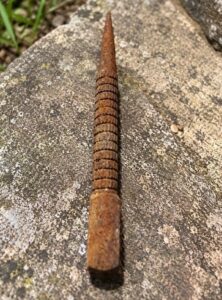
Finding an unfamiliar metal object beside a rural road can raise questions about its original purpose. A narrow piece of steel might resemble a machine component, a farming accessory, or an older hand tool. One possibility is a nail punch, also called a nail set—a compact woodworking tool used to drive finishing nail heads slightly beneath the surface of wood. However, an object’s location and general appearance are not enough to identify it confidently. Its dimensions, working tip, markings, and condition should be examined before deciding what it is. If those features match a nail set, the discovery may be a misplaced tool used for carpentry or household repairs.
A nail set generally has a slender steel body, a narrow working tip, and a broader striking end designed to receive hammer taps. Its purpose is to finish driving a nail after a hammer has brought the head close to the wood’s surface. Trying to complete that last step with the hammer alone can leave a dent or other unwanted mark, especially around small finishing nails. The nail set concentrates the force on the nail head, helping the user work more precisely. This makes it useful for baseboards, door casings, decorative moldings, cabinetry, and furniture, where exposed fasteners or hammer marks could interrupt an otherwise smooth finish.
To use the tool, first drive the finishing nail until its head is near the surface. Place the nail set’s working tip securely against the head, keeping it aligned with the nail. Gentle, controlled hammer taps then move the head just below the surrounding wood. The aim is a shallow recess rather than a deep hole. If the project requires concealed fasteners, that recess can be filled with a suitable wood filler. After the filler dries, the area can be sanded and finished according to the product instructions. For stained wood, choose a compatible filler and test its appearance first, since filled areas may absorb stain differently from the surrounding timber.
Choosing an appropriate tip size helps keep the tool seated on the nail head and reduces slipping. Nail sets come in different sizes, and their working tips are often shaped to locate securely against finishing nails rather than act as sharp piercing points. Some have textured bodies or cushioned grips to improve handling. Excessive hammer force can drive the nail too deeply or damage softer wood, so small, deliberate taps are preferable. Wear eye protection, keep fingers clear of the striking area, and check that both the hammer and nail set are in sound condition. An unidentified roadside object should not be struck until its purpose and condition are established, particularly if its ends are damaged or distorted.
Although powered nailers handle many fastening tasks, a manual nail set remains useful for small adjustments and detailed finishing. It takes up little storage space and can help with repairs to trim, furniture, and other wooden fixtures. Its effectiveness depends on matching the tool to the fastener and working carefully, rather than applying considerable force. For someone examining an unfamiliar steel object, understanding this function provides a useful identification clue without settling the question on appearance alone. Whether found in a workshop drawer or accidentally dropped outdoors, a genuine nail set represents a straightforward solution to a familiar problem: positioning a small nail head neatly while protecting the wood around it.