Some riddles look easy until you start doing the math. A simple story about a stolen $100 bill, a purchase, and some change can lead to several different answers—even though the numbers seem straightforward.
The puzzle is a great reminder that the key to solving a money riddle is to track what the shop owner actually loses, rather than counting the same money more than once.
The $100 Shoplifting Riddle
Here’s the challenge:
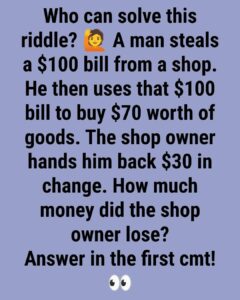
A man walks into a shop and steals a $100 bill from the cash register. He then uses that same stolen bill to buy $70 worth of merchandise. The shop owner accepts the bill without realizing it was stolen and gives the man $30 in change.
How much money does the shop owner lose in total?
Before reading on, take a moment to work it out. Is the answer $100, $130, $170, or something else?
The Correct Answer: $100
The shop owner loses $100 in total, assuming the goods are valued at $70 and the $30 change is genuine money.
The trick is to recognize that the stolen bill is used to pay for the purchase. You must account for the merchandise and the change without adding the original stolen bill a second time.
Let’s break it down.
Step 1: The Man Steals $100
The thief takes a $100 bill from the cash register.
At this moment, the shop owner is missing $100 in cash.
Step 2: The Thief Buys $70 Worth of Goods
The thief then hands over the same $100 bill to pay for $70 worth of merchandise.
Although the shop owner receives the bill back, the money was stolen from the shop in the first place. The payment does not represent a genuine gain for the owner.
The shop owner has now handed over $70 worth of goods.
Step 3: The Shop Owner Gives $30 in Change
Because the purchase costs $70, the shop owner gives the thief $30 in change.
The thief leaves with merchandise worth $70 and cash worth $30.
That adds up to:
- Merchandise: $70
- Cash change: $30
- Total loss: $100
Why the Riddle Confuses So Many People
The mistake is often counting the stolen $100 as one loss, then adding the $70 in merchandise and the $30 in change on top of it.
That would count the same transaction twice.
Think about the final result instead. The thief walks away with $70 worth of goods and $30 in cash. The shop owner gets the original $100 bill back, but it merely returns the money that was stolen from the register.
The owner’s net loss is therefore $100, not $200 or $170.
A Simple Way to Remember the Answer
Ignore the confusing sequence of events for a moment and ask one question:
What does the thief leave with that belongs to the shop?
He leaves with $70 worth of goods and $30 in cash.
Since $70 + $30 = $100, the shop owner’s total loss is $100.
Final Answer
The shop owner loses $100: $70 worth of merchandise and $30 in change.
It’s a deceptively simple brain teaser that shows why following the money—and avoiding double-counting—is often more useful than trying to perform the arithmetic in your head all at once.
Did you get the answer right on your first try, or did the riddle make you reconsider the numbers? Share it with a friend and see whether they solve it correctly!