He used to call me his little girl, even when I was pushing thirty and had my own apartment across town. We were close—really close—until we weren’t.
Six years ago, we had a fight. A stupid one, if I’m being honest. It started over politics, but underneath that was grief, control, and two people who didn’t know how to speak the same language anymore. I slammed the door on him that day. Neither of us reached out after.
And then came the call.
A woman from the facility told me he’d been admitted a month ago. Early signs of dementia, and then pneumonia hit. They were short-staffed. No visitors allowed inside. I didn’t even know he’d left his house.
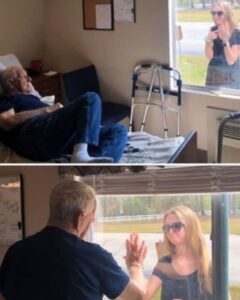
I drove there the next morning, heart racing like I was pulling up to some courtroom instead of a nursing home. When he saw me outside his window, he just stared. I waved. He blinked. And then, slowly, he sat up.
That second picture? That’s the first time we’d touched in over half a decade. Glass or not, it broke me.
He didn’t say much—couldn’t really—but he lifted his hand, and I matched it with mine. I told him I was sorry. I don’t even know if he heard me, or understood what I meant. But he closed his eyes, just for a moment, like he was holding something sacred.
I didn’t tell anyone I went. Not my brother, not even my partner. And now I’ve got a voicemail from the nurse that I still haven’t listened to.
I don’t know if I’m ready to hear what it says.
The message sat on my phone for three days before I finally pressed play. The nurse’s voice was calm but firm: “Your father has taken a turn. He’s asking for you. Please come soon.”
Asking for me? That didn’t make sense. My dad hadn’t asked for anything from me since our fallout. Even during holidays, birthdays, or family gatherings, he kept his distance. Why would he suddenly want me now?
But guilt gnawed at me. Maybe this was my chance to fix things—to do something right by him before it was too late. So, I packed an overnight bag, kissed my partner goodbye without explaining where I was going (because honestly, I wasn’t sure myself), and headed back to the nursing home.
This time, they let me inside. The lobby smelled faintly of antiseptic and old carpet, and the fluorescent lights buzzed overhead. A young aide led me down a hallway lined with doors, each one slightly ajar, revealing glimpses of lives slowed down by age or illness. At the end of the hall, she stopped and knocked softly on Room 12.
“Come in,” called a voice so weak I barely recognized it as my father’s.
When I stepped through the doorway, I froze. He looked smaller than I remembered, his once-broad shoulders hunched under the weight of blankets. His hair was almost entirely gray now, and his face seemed thinner, more fragile. But his eyes—those sharp blue eyes that could cut through any lie—they were the same.
“Hey,” I said awkwardly, hovering near the threshold.
“Close the door,” he replied, surprising me with how clear his words sounded. “You look like you’re about to run.”
I hesitated, then obeyed. Sitting in the chair beside his bed felt surreal, like stepping into a dream where everything is familiar yet wrong. For a long moment, neither of us spoke. I studied the patterns on the blanket while he watched me, waiting.
Finally, he broke the silence. “Why’d you come?”
His question caught me off guard. Wasn’t it obvious? Because he was sick, because he needed someone, because I owed him… But none of those answers felt true enough to say out loud.
“I… I got your message,” I stammered. “They said you were asking for me.”
He nodded slowly, as though confirming something to himself. “I wanted to see you. Before…” He trailed off, leaving the rest unsaid.
Before what? Before he forgot who I was? Before he couldn’t talk anymore? Before he died? All of those possibilities hung heavy between us.
“You remember the last time we talked?” I asked quietly, bracing myself for anger or disappointment.
To my surprise, he chuckled—a dry, raspy sound. “Of course I remember. You stormed out after calling me stubborn and pigheaded. Which, by the way, is fair.”
My jaw dropped. “What?”
“Oh, don’t act so shocked,” he said, waving a dismissive hand. “I know I wasn’t easy to deal with. Neither were you, sweetheart. You inherited that temper from me, you know.”
For the first time in years, I laughed—at him, at us, at the absurdity of sitting here hashing out old wounds when life itself felt so precarious. And somehow, that laugh broke the ice.
We spent hours talking that day. About everything. About nothing. About Mom, whose death six years ago had been the real trigger behind our fight. About my career, which he admitted he didn’t understand but was proud of anyway. About my brother, who had always played peacemaker and probably resented both of us for it.
At one point, he reached for my hand, gripping it tightly despite his frailty. “You know,” he said, “I never stopped loving you. Even when I didn’t know how to show it.”
Tears pricked my eyes. “I never stopped loving you either, Dad.”
Two weeks later, I received another call. This time, it wasn’t from the nurse—it was from my brother. His voice cracked as he delivered the news: Dad had passed away peacefully in his sleep.
I cried harder than I thought possible. Not just because he was gone, but because we’d found our way back to each other in time. Because he’d forgiven me, and I’d forgiven him. Because, in the end, love had won.
At the funeral, people approached me with stories about my dad—how kind he’d been, how generous, how funny. Each story painted a picture of a man I wished I’d known better sooner. As I stood by his grave, clutching a single white rose, I realized something important:
It’s never too late to repair what’s broken. Life is messy, complicated, and unpredictable. People hurt each other, intentionally or not. But forgiveness isn’t about forgetting; it’s about choosing to move forward together, even if only for a little while.
If you’ve been holding onto resentment, pick up the phone. Send a letter. Visit. Do whatever it takes to reconnect. You might not get another chance.
Thank you for reading my story. If it resonated with you, please share it with others. Let’s spread a little hope and remind ourselves that healing is always possible. ❤️