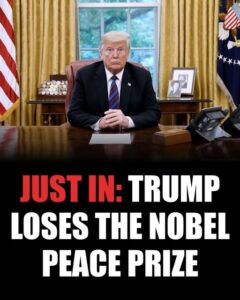
The Norwegian Nobel Committee awarded the 2026 Nobel Peace Prize to South African jurist Navanethem “Navi” Pillay on Friday, October 9, passing over President Donald Trump despite his public campaign to receive the honor.
The decision marks another setback for Trump’s efforts to secure the prestigious award, which he has argued he deserves for his role in international diplomacy and efforts to end conflicts.
On Wednesday, October 7, Trump defended his record in the Oval Office, telling reporters: “No president probably has settled any wars. I settled eight wars, and big ones.”
But the Nobel Committee selected Pillay, 85, recognizing her decades of work advancing human rights, international justice and the rule of law. The committee said the award was intended to emphasize that peaceful conflict resolution depends on legal institutions at a time when international law is facing growing political pressure.
In its official announcement, the committee highlighted Pillay’s work helping ensure that war crimes, crimes against humanity and genocide can be prosecuted. Nobel Committee announcement
Who Is Navi Pillay?
Pillay is a South African lawyer and former United Nations High Commissioner for Human Rights, a position she held from 2008 to 2014.
Raised under apartheid, she became a pioneering lawyer who defended anti-apartheid activists, including Nelson Mandela and others who challenged racial discrimination. She later served as a judge and president of the International Criminal Tribunal for Rwanda, where her work contributed to the development of international law on sexual violence and genocide.
She also served as a judge at the International Criminal Court and has continued to work on international legal issues.
The Nobel Committee described Pillay as a leading figure in the development of an international legal order, emphasizing the importance of holding perpetrators of serious crimes accountable.
Her selection comes as international courts and legal institutions face political pressure, including disputes over their investigations and jurisdiction. The committee’s stated rationale focused on the relationship between international law, accountability and lasting peace. Associated Press report
Trump’s Nobel Campaign Faces Another Setback
Trump has repeatedly argued that his diplomatic efforts warrant the Peace Prize, claiming that he has helped settle eight conflicts. However, the scope and durability of those claimed achievements have been disputed, and violence has continued or resumed in some regions associated with his diplomatic efforts.
The president also pointed to the actions of Venezuelan opposition leader María Corina Machado, who won the 2025 Nobel Peace Prize and presented Trump with her physical medal during a White House visit in January.
That gesture did not transfer the Nobel award itself. The Nobel Peace Prize is awarded to the designated laureate, and another person cannot become the official recipient simply by receiving or possessing the medal.
Trump’s pursuit of the award has attracted international attention, but the committee’s decision is independent of the White House and is based on its own assessment of candidates.
The 2026 award also arrives amid continued conflict involving Iran. Trump has presented his foreign policy as an effort to use American power to end wars and deter adversaries, while critics have questioned whether military action and pressure tactics are compatible with his stated pursuit of peace.
Does Losing the Nobel Peace Prize Matter Politically?
The decision carries symbolic and reputational significance, but its direct political consequences are much harder to establish.
For Trump, the award would have offered international recognition for his foreign policy and reinforced his claim that his diplomacy has produced historic results. Being passed over again denies him that particular form of validation.
But the outcome could also fit a political narrative he has used before: that international institutions and established elites refuse to recognize his achievements. Supporters may interpret the decision as evidence of institutional hostility, while critics may view it as a judgment that his record does not meet the committee’s criteria.
Neither reaction, by itself, demonstrates how the decision will affect public opinion or voting behavior.
A Nobel Peace Prize decision is not a referendum on a president’s domestic popularity. Its electoral impact would depend on whether voters care about the award, how they assess Trump’s foreign policy and whether the issue influences their broader views of his administration.
A Symbolic Defeat, Not an Electoral Verdict
Pillay’s selection gives the 2026 Peace Prize a clear focus on international law and accountability. For Trump, the decision represents another missed opportunity to receive an honor he has publicly sought.
Whether the outcome damages his political standing or reinforces his argument that he is unfairly treated remains uncertain. The award does not change his formal powers or determine the outcome of the November midterm elections.
Ultimately, the Nobel Committee has made its choice. The political meaning of that choice will be shaped less by the announcement itself than by how Trump, his supporters, his critics and voters interpret it in the weeks ahead.