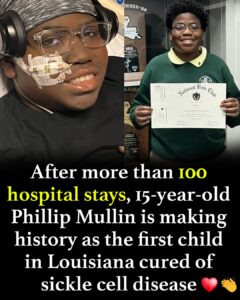
After more than 100 hospitalizations and years of pain, an Alexandria teenager is looking toward a future filled with hope, family and dreams of becoming a doctor.
For 15-year-old Phillip Mullin of Alexandria, Louisiana, childhood has involved challenges that most teenagers can hardly imagine. Living with sickle cell disease meant enduring severe pain, repeated hospital stays and the constant uncertainty of never knowing when the next medical crisis might arrive.
Now, after an extraordinary medical journey, Phillip is entering a new chapter of his life.
In October 2026, Phillip celebrated a major milestone after receiving gene therapy at Manning Family Children’s in New Orleans. According to the hospital, he is the first child in Louisiana to receive gene therapy for sickle cell disease and the first patient in the state to receive the treatment known as LYFGENIA.
His medical team described the outcome as a functional cure, offering hope for a future with fewer of the devastating complications that had shaped so much of his childhood.
A Childhood Marked by Pain and Hospital Stays
Sickle cell disease is an inherited blood disorder that causes red blood cells to become rigid and sickle-shaped. These cells can block blood flow, leading to severe pain episodes and potentially serious complications, including infections and strokes.
For Phillip, the condition meant more than 100 hospitalizations by the age of 15. His family spent years searching for treatments that could reduce his suffering and give him a chance at a different kind of life.
Eventually, they found a possible path forward through specialized care at Manning Family Children’s.
Phillip and his mother, Shataka Figgins, worked with his medical team to explore gene therapy. The teenager took an active role in understanding his options, researching the treatment and asking questions about what it could mean for his future.
The Groundbreaking Treatment That Changed His Future
Phillip’s treatment required months of preparation and several demanding medical procedures.
His journey included blood exchange procedures, collection of his blood-forming stem cells, genetic modification of those cells, chemotherapy and finally the infusion of the treated cells back into his body.
The treatment was not easy. During recovery, Phillip developed severe inflammation of the mouth and throat, known as mucositis. The complication required intensive supportive care, including a feeding tube and intravenous pain medication.
But he continued through the difficult recovery process with the support of his family and medical team.
LYFGENIA is a one-time gene therapy designed for eligible patients aged 12 and older with sickle cell disease and a history of painful vaso-occlusive events. It modifies a patient’s own blood-forming stem cells so the body can produce a form of hemoglobin that helps prevent red blood cells from sickling.
Although the treatment represents a major advance, it requires specialized medical care and carries significant risks. Phillip’s outcome is a remarkable milestone, but his medical team will continue to monitor his health.
A Mother Finally Has Room to Breathe
For Phillip’s mother, the achievement means far more than a medical milestone.
Years of hospitalizations and painful crises brought an ongoing fear that her son might not survive another serious complication. The possibility of a future with fewer sickle cell crises offers a chance to begin letting go of some of that fear.
The family’s journey involved difficult decisions, long periods of preparation and a recovery that tested Phillip physically. Their relief reflects the emotional toll that chronic illness can place on an entire family.
For parents who have watched their children struggle with serious illness, the hope of seeing them enjoy an ordinary childhood can be life-changing.
The Moment Phillip Rang the Bell
On October 23, Phillip celebrated his achievement by ringing the bell at Manning Family Children’s, surrounded by family, friends and members of his care team.
The celebration marked more than the end of one stage of treatment. It represented the beginning of a future that may offer him greater freedom from the painful crises that repeatedly interrupted his childhood.
The hospital also unveiled a custom LEGO display in honor of Phillip’s love of building with LEGO bricks.
The thoughtful tribute reflected something important about the teenager’s story: after months of medical procedures and recovery, he is still a young person who enjoys spending time with his family and doing the things that make him happy.
A Dream to Help Other Children
Phillip’s experience has also shaped his ambitions for the future.
He hopes to become a hematologist-oncologist, a doctor who treats blood disorders and cancers. Having personally experienced the fear, pain and uncertainty of a serious blood disorder, he wants to help other patients feel understood.
His dream is rooted in the belief that a physician can offer more than medical treatment. A doctor who understands what a patient is experiencing can also provide reassurance, compassion and support through the hardest moments.
Phillip’s journey has given him a firsthand understanding of why that connection matters.
For Now, He Just Wants to Be a Kid
Despite everything he has endured, Phillip is still a 15-year-old with ordinary teenage wishes.
For now, he is looking forward to going home, sleeping in his own bed and building LEGO creations with his little sister.
Those simple moments carry a special meaning after years in which hospital stays and medical procedures repeatedly disrupted family life.
His story is a reminder that medical breakthroughs are not only about laboratory discoveries or hospital milestones. They are also about the everyday experiences that patients may finally have more opportunity to enjoy.
For Phillip and his family, gene therapy has opened the door to a future filled with new possibilities.
His journey is far from a reason to forget the challenges of sickle cell disease, but it offers a powerful example of how medical advances can transform a young patient’s outlook.
After more than 100 hospitalizations, Phillip is looking ahead to school, family time and a dream of becoming a doctor himself.
And right now, one of the most meaningful things he can do is simply be a kid.
We wish Phillip and his family continued strength, good health and many happy days ahead. ❤️🧱